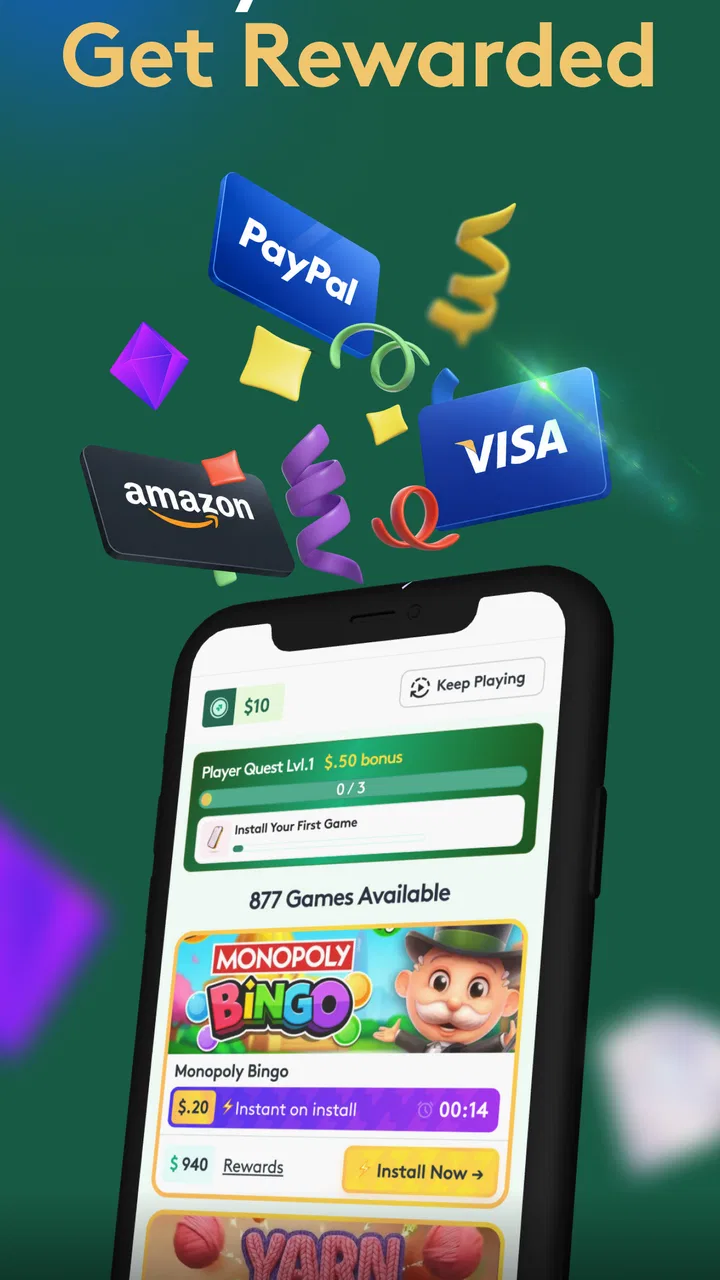
Earn Money & Rewards: Prograd
- 4.4
- Rating
- 100.00K
- Installs
- Free
- Price

 Analysis by App-foxy
Earn Money & Rewards: Prograd is the kind of lifestyle app I would open when I have a few spare minutes and want to turn casual phone time into a chance at cash or gift cards. Its basic idea is easy to understand: I can play games, answer surveys, and work toward rewards rather than simply scrolling. That makes it more interesting than a standard entertainment app, although it also means the experience depends heavily on what activities are available and how smoothly my phone can stay connected.
After spending time with it, my impression is that Prograd works best as a flexible side activity, not as a serious income source. The appeal is convenience. I can check for a survey while waiting for an appointment, try a game during a commute, or return later when I have a stronger connection. The trade-off is that every task has to be approached with realistic expectations. This is a rewards app, not a replacement for paid work, and the amount of effort required can vary from one activity to another.
How Prograd fits into everyday mobile use
Developed by Prograd, this free Lifestyle app is aimed at adults who are comfortable exchanging attention and time for rewards. It has a Mature 17+ age rating, which is important because it is not an app I would recommend handing to a child simply because games are part of the experience. The current version is 1.9.1, and it is available for devices running Android 7.0 or later.
You May Also Like

 AccuWeather: Weather Radar
AccuWeather Review: A Quick, Clear Forecast for Everyday Decisions
For everyday plans, the best forecast is the one you can understand quickly. AccuWeather makes rain timing, radar, and local conditions easy to act on, with a few trade-offs.

 Hill Climb Racing
Why Hill Climb Racing Still Turns Crashes Into One More Run
A tiny car, a bumpy hill and one more upgrade: Hill Climb Racing keeps resurfacing because its simple chaos makes every near-miss feel personal.

 AliExpress - Shopping App
AliExpress Makes Global Shopping Feel Personal, but Shoppers Bear the Risk
AliExpress turns a global marketplace into a pocket-sized discovery engine. Its reach is useful, its shopping loop compelling, and its trade-offs easy to miss.

 Lords Mobile: Kingdom Wars
Lords Mobile Is a Kingdom-Building Routine, Not a Quick Match
A case-by-case verdict on the building, battles, device demands, and social commitments that make Lords Mobile rewarding for some players and exhausting for others.

 PDF Scanner app - TapScanner
TapScanner Makes Paperwork Easier to Capture, Check, and Share
TapScanner makes scanning with a phone feel less like a rescue operation and more like a dependable step in getting work done. Its capture tools are useful, though not flawless.

 Block Blast!
 Shows How Much a Puzzle Game Can Leave Out
A quiet grid game shows why puzzle players increasingly value instant clarity, repeatable skill and low-pressure play—and where the genre still needs to catch up.
More From Our News Desk
View All News


The first thing I noticed is that the app combines two familiar reward formats instead of focusing on just one. Surveys suit people who prefer short question-and-answer sessions, while games may feel less repetitive for someone who would rather interact with an activity than fill in forms. That combination gives Prograd a broader use case than a survey-only app, but it also creates different expectations. A quick questionnaire and a game-related task do not demand the same patience, concentration, or network stability.
I would describe the app as a “check-in regularly” service rather than something that rewards one long session. The useful habit is to open it when I already have spare time, review the available options, and choose an activity that fits the moment. If I am standing in a queue, a short survey may be practical. If I am at home with a stable connection and more time, trying a game can make more sense. This simple matching of task to situation prevents the app from feeling like an obligation.
Its public reception is encouraging: it holds a 4.4 average from around 20 thousand ratings, with roughly 1.2 thousand written reviews and over 100 thousand installs. Those figures suggest that Prograd has attracted a meaningful audience, but they should not be treated as a promise that every user will have the same reward experience. Availability, patience, and the quality of a person’s mobile connection still shape the result.
Why connectivity matters more than it first appears
Prograd’s central activities naturally require communication with its online service. Surveys need to load questions and submit answers, while game-related tasks may need progress or activity information to be recognized. I therefore would not choose this app expecting it to be equally useful in airplane mode, in a basement with no signal, or in a crowded place where the connection keeps dropping. The app’s value is tied to being able to load, interact, and submit without interruption.
This changes how I use it. I avoid beginning a longer activity just before entering a tunnel or boarding a flight. A short interruption can be more than an annoyance: it may force me to wait, restart, or wonder whether my progress was recorded. Even when an app handles reconnection gracefully, uncertainty makes the experience less relaxing. My practical rule is to start only when the network looks dependable enough to finish the immediate step.
There is also a difference between a connection that is technically present and one that is usable. A phone can show a signal while pages load slowly or requests time out. That matters when a survey has several screens or when a game-related activity requires the app to move between different stages. I found that a stable Wi-Fi connection is the safer choice for longer sessions, while mobile data is better reserved for brief checks unless my signal is strong.
The best reward strategy is to protect the session before starting it. I close unnecessary downloads, avoid switching repeatedly between weak networks, and give the app a moment to load its available activities before choosing one. These are small habits, but they reduce the chance of wasting time on a task that cannot be completed smoothly.
Using it in real mobile situations
A realistic example is a delayed appointment. I might have fifteen minutes, a charged phone, and a reliable connection. In that situation, I can open Prograd, look through the current choices, and select a survey that appears short enough for the time available. If the questions become more involved than expected, I can decide whether to continue rather than feeling trapped by the original estimate. The important point is that the app fills an existing gap in my day; it does not require me to create a special schedule around it.
Another situation is a daily commute. Here I would be more cautious. Moving between towers, entering underground areas, and dealing with crowded networks can make an interactive task less predictable. I might browse what is available at home and save the actual activity for a stable connection. If I do use it while traveling, I prefer a short action and keep enough time to handle a reload or interruption.
At home, Prograd is easier to approach deliberately. I can compare a survey with a game option, decide how much time I am willing to spend, and stop when the activity no longer feels worthwhile. This is where the app has its strongest advantage over a simple survey platform: I am not limited to one type of task. Still, I would not assume that the most entertaining option is automatically the most efficient. The right choice depends on whether I value variety or want to finish a quick activity with minimal concentration.
For people who are careful with mobile data, the app calls for a little planning. Games and media-rich screens can be more demanding than plain text questions, even when the app itself feels lightweight. I would use home Wi-Fi for anything that appears likely to involve extended interaction and reserve cellular data for checking the app or completing a brief survey. This approach keeps Prograd from quietly becoming an unnecessary part of my data usage.
What happens when a session goes wrong
Connection failures are the main friction point I would want a new user to anticipate. A survey can stop loading, a submission can take too long, or an activity can appear to need a refresh. The frustrating part is not always the interruption itself; it is the uncertainty about whether the last action counted. When rewards are involved, users naturally want a clear result, so a vague loading state can make a small task feel disproportionately stressful.
My recovery approach is deliberately conservative. I first wait rather than tapping the same button repeatedly. Duplicate taps can make it harder to tell whether the app is processing a request or whether nothing happened. If the screen remains stuck, I check the connection, move to a more reliable network when possible, and reopen the relevant area. I also avoid immediately starting a different task until I understand whether the previous one finished.
This is one reason I would not use Prograd during an especially expensive or limited data situation. If a session fails, the wasted time may be more irritating than the potential reward is worth. The app makes more sense when I can treat an interruption as a minor inconvenience rather than a meaningful loss. Users with unreliable service should be especially selective about which activities they begin.
Another useful habit is to keep expectations modest when returning after a break. I would not assume that an activity seen earlier will still be waiting in exactly the same form. Instead, I check the current screen again and choose from what is available at that moment. This avoids building a plan around an option that may no longer be practical when I have time to complete it.
That workflow also helps with battery management. A phone that is already low on power is a poor place to start a longer activity, especially if the connection is weak and the device is working harder to maintain it. I prefer to use the app when the phone is charged and the network is steady. This is not a special feature of Prograd, but it is a meaningful part of whether the rewards experience feels efficient in real life.
Surveys, games, and choosing the right trade-off
Surveys are likely to appeal to users who want a clear beginning and end. They can be easier to fit into a short break, but they may also feel repetitive, and not every questionnaire will suit every person. I would read the opening information carefully and decide whether the subject and expected effort fit my available time. Starting every survey without considering that trade-off is an easy way to make the app feel less rewarding.
Game activities offer a different kind of value. They can make the process feel less like completing forms, which is useful for someone who enjoys interactive tasks. The downside is that games may require more sustained attention and a longer uninterrupted session. They are therefore less convenient when I am waiting for a bus or dealing with a weak signal. I would choose them when I can stay focused and connected, not merely because they sound more fun.
A non-obvious advantage of having both formats in one app is that I can manage mental energy. On a tiring day, a simple survey may be easier than learning or playing something new. On a day when surveys feel tedious, a game can provide variety. I would not judge the app only by the largest-looking reward opportunity; I would also consider how much concentration, time, and connectivity the activity demands.
Compared with ordinary survey apps, Prograd is more appealing to people who dislike relying on one format. Compared with a conventional mobile game, it adds a practical reason to return, but it may not offer the depth or polish that a dedicated game player expects. And compared with cashback or shopping-reward services, its focus is on participation rather than purchases. That makes it a better fit for people who want to earn through activities, not for someone who mainly wants rewards from spending they were already planning to do.
There is a psychological trade-off here. Because the app presents entertainment and rewards together, it can be easy to keep going after the activity has stopped being worthwhile. I recommend setting a personal time limit before starting. If I decide in advance that I will spend only a short break on it, I am less likely to chase a reward simply because I have already invested time.
Who should use Prograd, and who should skip it
I think Prograd is a good match for adults with occasional spare time, a reasonably dependable connection, and an interest in switching between surveys and games. It is particularly suitable for someone who wants a free app that can be checked casually rather than followed as a strict earning program. The option to choose between different activity styles is its most practical strength.
I would be more hesitant to recommend it to anyone looking for predictable income. Reward apps generally depend on available activities and personal participation, so the experience is better understood as occasional value than guaranteed earnings. Someone who dislikes surveys, has very limited data, or becomes frustrated by interrupted mobile sessions may find a simpler offline pastime more satisfying.
It is also not the right choice for a child, despite the presence of games, because the age classification is Mature 17+. Parents should not treat the game element as a reason to overlook that rating. Adults who are comfortable with the category can make a more informed decision by considering whether they are happy to exchange time and attention for the possibility of cash or gift cards.
Before committing to a long session, I would begin with a short visit. Check how quickly the app loads on your usual connection, see whether the available activities match your interests, and notice how comfortable you feel with the amount of time involved. This small trial tells me more about personal fit than the headline concept alone.
My connectivity verdict
Prograd is most convincing when I treat it as a connected, on-demand companion for spare moments. Its combination of games and surveys gives it more flexibility than a single-purpose rewards app, and its free entry makes experimenting easy. The 4.4 average and audience of over 100 thousand installs show that many people have chosen to try it, while the Mature 17+ rating clearly defines who should be using it.
The main limitation is not complicated navigation or a lack of ambition; it is the dependence on a reliable online session. A weak network can turn a quick activity into waiting, reloading, or uncertainty. My best results come from using Wi-Fi for longer tasks, mobile data for brief checks, and avoiding sessions when I know I will soon lose signal. Those habits do not change what the app offers, but they make the experience much less frustrating.
I would recommend Earn Money & Rewards: Prograd to an adult friend who wants a casual way to use spare time and enjoys having both surveys and games available. I would describe it honestly as a small-reward option, not a financial solution. If you approach it selectively, protect your connection, and stop when the time trade-off no longer feels sensible, it can be a worthwhile addition to a lifestyle app collection. If you need guaranteed earnings, offline access, or a distraction-free game, a different type of app will suit you better.
Overall, my verdict is positive but measured. The strongest reason to install it is flexibility: I can choose an activity that fits my mood and the length of my break. The strongest reason to be cautious is connectivity: the app works best when the phone, network, and available time all cooperate. Used with those limits in mind, Prograd feels like a practical way to make occasional downtime more purposeful without pretending that every minute on a screen has the same value.
FAQs for Earn Money & Rewards: Prograd
01What is Earn Money & Rewards: Prograd?
Earn Money & Rewards: Prograd is a personal finance and rewards app designed to help users improve their money habits while earning benefits for completing eligible activities. Depending on your location and account status, these activities may include learning about finances, taking part in offers, completing surveys, or engaging with partner promotions. Available features and rewards can vary, so reviewing the current terms inside the app is important before getting started.
02How can I earn rewards with Prograd?
Prograd may offer rewards through a combination of financial education, in-app tasks, partner offers, and other qualifying activities. After creating an account, users can explore the available opportunities and check the requirements for each one before participating. Rewards are not necessarily guaranteed for every action, and some offers may have deadlines, eligibility conditions, verification steps, or limited availability based on your country and personal profile.
03Is Earn Money & Rewards: Prograd free to download and use?
The app can generally be downloaded without an upfront charge, but users should still check the Google Play Store or Apple App Store listing for the latest pricing information. Some features, partner services, or financial products promoted through the app may have their own fees, conditions, or eligibility rules. Always read the relevant disclosures carefully and avoid assuming that every feature or reward is completely free.
04How do I receive my Prograd rewards?
Reward delivery depends on the type of activity completed and the options currently supported by Prograd. The app may require users to reach a minimum balance, verify their identity, or complete additional steps before a payout can be processed. Processing times can also vary, and some rewards may be issued through specific payment methods or partner platforms. Check the withdrawal instructions and account requirements before investing time in an offer.
05Is Prograd safe and suitable for everyone?
Prograd should be downloaded only from an official app store, and users should review its privacy policy, permissions, and terms before registering. Because the app may involve financial information, personal details, or third-party offers, use a strong password and provide information only through legitimate in-app screens. Eligibility may depend on age, residency, and other requirements, so the service may not be available or appropriate for every user.
Pros
- Clear progress tracking helps users monitor earnings and completed goals.
- Offers practical financial education alongside its reward features.
- Simple interface makes key tasks and account information easy to find.
- Useful for building consistent saving and money-management habits.
- Rewards can provide extra motivation for completing financial activities.
Cons
- Eligibility and available features may vary depending on location or age.
- Some rewards may require completing several steps before becoming redeemable.
- Earnings are generally modest and should not be treated as regular income.
- Certain activities may involve sharing personal or financial information.
- Reward availability and redemption rules can change over time.

Earn Money & Rewards: Prograd
Gallery